


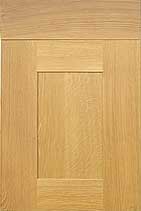
Download our useful kitchen doors materials PDF here
Door Materials
- Timber
- Melamine
- Veneer
- Vinyl Faced MDF
- Painted/Lacquered MDF
- Painted Vinyl MDF
- Painted Timber
- Acrylic Faced MDF
Timber 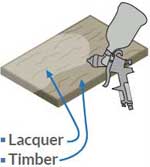
Our timber is selected only from premium grade trees sourced from environmentally regulated and renewable forests.
Using traditional mortice and tenoning techniques, doors are carefully assembled in our workshops before being sanded and finished with several layers of high quality lacquer. Special care is taken to ensure that a uniform finish is achieved and a highly durable surface created.
Kitchens that fall into this category are Bramley, Linwood, Norton, Helmsley, Harewood & Silsden.
Melamine MFC 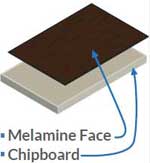
Melamine faced chipboard, (MFC) is manufactured from resin coated particles of softwood. These particles are evenly spread over a flat plate bonded together under high pressure.
The melamine face is effectively the decorative finish that is seen on the external sides of the board and is available in numerous colours and wood grains.
Various textures can be applied to the melamine during the manufacturing process to create gloss and matt finishes and even heavily embossed wood grain effects.
Kitchens that fall into this category are Cento, Palazzo & Verona.
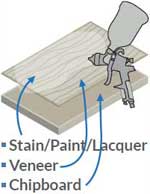
A veneer is a thin slice of timber taken from a log which is then bonded to a chipboard or MDF (medium density fibreboard) substrate and sealed with either a stain and/or lacquer.
The advantage of using veneers over solid timber is the ability to maintain the consistency of the grain pattern and colour.
This refers to some door centre panels and some plinths are made with a timber veneer on the front, so this will have the same finish as the doors with the wood grain effect in there to match the doors.
Vinyl Faced MDF (Foil Wrapped)
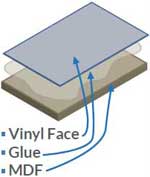
Vinyl and foil is one of the more widely used materials in the manufacture of kitchen doors.
The versatility of this type of material means that it can be printed with a wood grain effect to create the look of a natural timber door. Single colour vinyls and foils (uni-colour) are particularly useful for replicating the look of a matt painted surface and high gloss finishes.
Kitchens that fall into this category are Linton & Dalby.
Painted/Lacquered MDF

The first process requires the doors to be primed, they are then placed in an oven to cure and once cured, are de-nibbed (finely sanded). The top coat is then applied and the doors are then returned to the oven for further curing to create a highly durable and resilient surface.
Kitchens that fall into this category are Carrera, Carrera Gloss, Stanbury, Clayton, Palazzo Gloss, Luca & Luca Gloss.
Painted Vinyl MDF
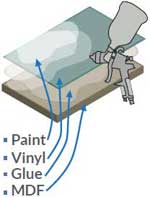
The first process requires the doors to be primed, they are then placed in an oven to cure and once cured, are de-nibbed (finely sanded).
The top coat is then applied and the doors are then returned to the oven for further curing to create a highly durable and resilient surface.
Kitchens that fall into this category are Malton.
Painted Timber
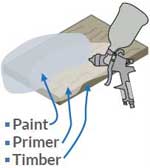
The first process requires the doors to be primed, they are then placed in an oven to cure and once cured, are de-nibbed (finely sanded). The top coat is then applied and the doors are then returned to the oven for further curing to create a highly durable and resilient surface.
Kitchens that fall into this category are Bramley, Linwood, Norton, Helmsley, Harewood & Silsden.
Acrylic Faced MDF
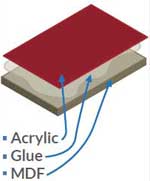
The finish of acrylic imitates glass but is much more cost effective.
Kitchens that fall into this category are Altino.
Start planning your kitchen today!

If you are ready to unleash your creativity then you can start designing your new kitchen or utility room today, from the comfort of your home with our free, online kitchen planner!
Up to 50% off competitor kitchen prices
At DIY Kitchens, not only do you get a quality rigid built kitchen but you also get it at a fabulous price too! Price your kitchen up on our site and you could see savings of up to 50% off other kitchen quotes that you’ve had.
Take a look at our kitchen price comparison page here.
Real customer kitchens
Get some inspiration for designing your own new kitchen with over 4,000 pictures of our customers’ kitchens that they ordered from us.

Related articles